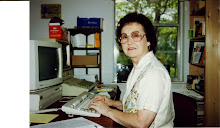
In forthcoming blogs I hope to feature other writers and their books, along with an ocassional family blog. During the next few days watch for a post from my older son Tony, who is helping me with promotion for my new novel and trying to help me learn some things about using social media.
Tony, an ordained minister, former pastor and counselor, Christian School teacher and principal, has worked retail with computers and the new Smart Phones. He enjoys technical "stuff" whereas his mother is lost with it. But we do have some things in common, such as writing, some of which he will share with you as one of my guest bloggers.
Watch for his blog, coming soon, about the lady to whom my book of local history, EARLY SETTLERS OF THE K-SPRINGS/CHELSEA AREA, was dedicated--things he remembers about her as his great-grandmother, along with stories he heard about her and from her while growing up.
This brave and interesting lady who, widowed shortly before her fourth child was born, farmed, taught school, raised a grandson, and recorded historical notes, along with births, deaths and marriages of everyone she heard of from the time she was a young girl in Roanoke, Alabama in the late 1800s.
I think you will enjoy her stories. And you may want to share a few of your own as comments on this blog. If you have long tales to share, please "follow" this blog, IN HIS STRENGTH, then share your stories with us on our facebook page at shelbasheltonnivens,author. While you are on our author page, you might like to enter our drawing for a free copy of EARLY SETTLERS OF THE K-SPRINGS/CHELSEA AREA by "liking" that page, "sharing" it on your own facebook timeline, and writing a "comment" on it. (REMEMBER TO DO ALL 3 TO GET YOUR NAME IN THE POT FOR THE OCTOBER 1 DRAWING.)
Showing posts with label genealogy. Show all posts
Showing posts with label genealogy. Show all posts
Tuesday, September 17, 2013


Saturday, July 30, 2011
COURTIN' IN THE GOOD, OLE DAYS: Frank and Ressie Vick Kendrick

Ressie’s family was from Joiner Town between Columbiana and old East Saginaw, which is now part of Chelsea. But her father George Vick moved the family around a lot, she said, following his work with a timber-cutting operation. That’s how they came to live at East Saginaw where she met Frank Kendrick.
They didn’t actually play together as children, Ressie said, because they were both very bashful. But Frank found ways to get her attention.
She recounted with a smile, while Frank just listened and grinned, “One day I was out in the yard washing clothes for Mama’s twin babies, when directly something shined in my face, and it was him out on the porch with a mirror.”
“Do you remember the first letter I ever wrote you?” he asked her.
She did, of course, but he told the story anyway for my benefit -- and because he was enjoying their remembrances as much as Ressie and I were.
“It was when I was a teenager and worked for Saginaw Lumber Company. I would walk right past her house going to the railroad track where I rode on a hand car to the lumber company. Well, on this particular morning, I walked up close to the open front door and tossed a letter to her inside the house.”
Ressie confided that his first talk of marriage was also in a letter. But they later made wedding plans in person, sitting in the parlor at the Vick home. She told him that night, “You’ll have to ask Daddy.”
“Well, you’ll have to go in there with me to ask him,” he told her.
So Ressie agreed and together they headed for the room where Mr. Vick sat. But just as they reached his open doorway, Ressie slipped on by it, leaving Frank to face her father alone.
Sixty-plus years later, sitting under a shade tree with Frank and me, she still found amusement in the trick she’d played that day. “I went out and hid behind the house until the men folk finished their talking.” she laughed.
Frank Kendrick and Ressie Vick were married on July 26, 1908.
Saturday, June 25, 2011
DISCOVERY AT K-SPRINGS
As undergrowth was cleared from the K-Springs property Elmira Kendrick had purchased at the 1873 tax sale, five springs were discovered.
Jemima Kendrick, my husband Ken’s grandmother told me, when I was researching for the K-Springs/Chelsea book, “Grandpa (Elmira Kendrick’s son Jud) told me this now. There was one spring of pure water. Further down the branch, nearer the cabin, was a spring of sulfur water, and one was a mixture of minerals. Grandpa told me that the water containing a mixture of minerals is called kalebrate.”
She could not recall the type of water in the other two springs. Other early visitors to the springs recalled that one of them had copper water.
Clifton Kendrick (grandson of Elmira, son of Luther) recalled that the family used water from the sulfur spring, except for washing clothes. It would stain clothing, he said, so “Aunt Mary” (Elmira’s youngest child) would take them to a spring “way over at Uncle Elbert’s.” (Elbert Kendrick lived along where there is now an empty lot east of the Edgar Smith family lives.
Clifton speculated, “The spring of free-stone water must not have been discovered until after the year 1900, because it was a big spring of pretty, clear water.”
After its discovery, people came from all around to wash clothes, bathe the kids and take home bucketsful the pretty, clear water for other household uses. For many years it provided water, not only for private homes, but for a church, parsonage and school.
It was from these springs on the Kendrick property that the community, school and church derived their name.
![]()
Jemima Kendrick, my husband Ken’s grandmother told me, when I was researching for the K-Springs/Chelsea book, “Grandpa (Elmira Kendrick’s son Jud) told me this now. There was one spring of pure water. Further down the branch, nearer the cabin, was a spring of sulfur water, and one was a mixture of minerals. Grandpa told me that the water containing a mixture of minerals is called kalebrate.”
She could not recall the type of water in the other two springs. Other early visitors to the springs recalled that one of them had copper water.
Clifton Kendrick (grandson of Elmira, son of Luther) recalled that the family used water from the sulfur spring, except for washing clothes. It would stain clothing, he said, so “Aunt Mary” (Elmira’s youngest child) would take them to a spring “way over at Uncle Elbert’s.” (Elbert Kendrick lived along where there is now an empty lot east of the Edgar Smith family lives.
Clifton speculated, “The spring of free-stone water must not have been discovered until after the year 1900, because it was a big spring of pretty, clear water.”
After its discovery, people came from all around to wash clothes, bathe the kids and take home bucketsful the pretty, clear water for other household uses. For many years it provided water, not only for private homes, but for a church, parsonage and school.
It was from these springs on the Kendrick property that the community, school and church derived their name.

Story and photo taken from EARLY SETTLERS OF THE K-SPRINGS/CHELSEA AREA
by Shelba Shelton Nivens
(email for permission to quote or copy shelbasn@juno.com)
Sunday, June 19, 2011
Begetting a Community
“It was over a century and a half ago that James Lewis Kendrick, with his wife, children and several other relatives, left South Carolina to beat a path through the wilderness to the new Alabama Territory. Today, descendants of this little band of pioneers are scattered throughout Shelby County in the heart of the State of Alabama. There is, in fact, a thriving rural community along about the center of the county which was named for the Kendrick family.
“‘Kendrick Springs’ the place was first called when early settlers would meet at springs located on property purchased by a Kendrick widow at an 1873 tax sale, to do the family wash, bathe the kids, and carry home buckets of water for other household uses. (The springs were located down the hill behind the little white church building where St. Catherine’s Episcopal Church meets.) The name (of the community) has now been shortened to “K-Springs” but the Kendricks and their descendants still make up a large portion of the community’s population. It is the Kendricks of Kendrick Springs -- and other pioneers who helped to carve out of the wilderness a loving, caring community -- that we wish to share on these pages.”
*****
This is the beginning of a book of local history that I wrote around thirty years ago. Over 100 people came to the first book signing on the day it came off the press. Since then it has sold to people across the country and in Australia. It is now in its third printing.
Since there still seems to be an interest in the story of these early settlers, and since the woods, hills and hollows surrounding the community are now filled with sub-divisions full of people who may know nothing about the people who once lived where they live, I thought I would tell a little of their stories in future blogs. I’ll take most of the stories from the book, and maybe a few from a play script I wrote several years ago about the history of the K-Springs church and community people.
I hope you find their stories as interesting as I did as I wrote and put them together.
Story taken from EARLY SETTLERS OF THE K-SPRINGS/CHELSEA AREA
by Shelba Shelton Nivens
(email for permission to quote or copy shelbasn@juno.com)
“‘Kendrick Springs’ the place was first called when early settlers would meet at springs located on property purchased by a Kendrick widow at an 1873 tax sale, to do the family wash, bathe the kids, and carry home buckets of water for other household uses. (The springs were located down the hill behind the little white church building where St. Catherine’s Episcopal Church meets.) The name (of the community) has now been shortened to “K-Springs” but the Kendricks and their descendants still make up a large portion of the community’s population. It is the Kendricks of Kendrick Springs -- and other pioneers who helped to carve out of the wilderness a loving, caring community -- that we wish to share on these pages.”
*****
This is the beginning of a book of local history that I wrote around thirty years ago. Over 100 people came to the first book signing on the day it came off the press. Since then it has sold to people across the country and in Australia. It is now in its third printing.
Since there still seems to be an interest in the story of these early settlers, and since the woods, hills and hollows surrounding the community are now filled with sub-divisions full of people who may know nothing about the people who once lived where they live, I thought I would tell a little of their stories in future blogs. I’ll take most of the stories from the book, and maybe a few from a play script I wrote several years ago about the history of the K-Springs church and community people.
I hope you find their stories as interesting as I did as I wrote and put them together.
Story taken from EARLY SETTLERS OF THE K-SPRINGS/CHELSEA AREA
by Shelba Shelton Nivens
(email for permission to quote or copy shelbasn@juno.com)
Saturday, March 26, 2011
TRACING THE WYATTS FROM VIKINGS TO SHELBY COUNTY, ALABAMA
(This is my family line through my grandmother Edna Cordelia Seagle Shelton Fulgham. This post is especially for people who have contacted me about their interest in, or connection to Wyatt family history -- and any others interested in genealogy, history and tales of intrigue)
Did you know that back beyond the Wyatt name we can claim some of the same ancestors as King Henry VIII of England -- who stole Anne Boleyn from our ancestor Thomas Wyatt? This can be traced through dozens of history books, websites, movies and even some of Shakespeare’s plays. Some of our ancestors appear in the Tudor television series and are featured in novels.
A book I’m reading now (THE LADY IN THE TOWER, by Jean Plaidy) is about Anne Boleyn and King Henry VIII. Thomas Wyatt and his sister Mary are prominent characters in it as friends of Anne Boleyn and her family. Their estate and castle, Allington, is “next door” to the Boleyn estate and castle Hever. Thomas Wyatt and Anne are together a lot growing up and as adults (when their life activities allow it). Actually, Thomas is in love with Anne.
Anne and King Henry (parents of the first Queen Elizabeth) are not our ancestors. But Thomas and his wife Elizabeth Brooke are. It is through Elizabeth that we are descendants of kings and queens of England (and other countries) and Viking kings and warriors.
Our Wyatt family tree has already been traced in bits and pieces by other people back to the Vikings in the year 160 A.D. All we have to do is put all the pieces together by digging a little deeper into information we already have: info on family members we know, gravestones of people we once knew, information passed down to us through generations of family members, census records on the oldest family member we knew or have information on, etc. Check the internet, history books, old letters, photos, newspaper articles…. And be sure to check out surnames of people who marry into the family.
It was when I checked Elizabeth Brooke’s family name (wife of Thomas Wyatt I) on the internet, that things really opened up for me.
Sound easy? Sound like fun? It is. But it took lots of digging off and on for several years for me to find all the connections to trace some of the people through Norway, France, Germany, even Jerusalem. I feel sure that someone smarter than I and with more knowledge in this sort of thing can put all the pieces together much quicker.
Information was more difficult to verify after our second generation in America. Our family line was more difficult to trace. I had no doubt that Martin’s information was correct, but felt I should do my own work to trace our line. So, through census records, christening, marriage and death records, and family charts on the web, I came up with the same people that he did.
It was the brief notation in his book about Thomas Wyatt II dying at the Tower of London, that prompted me to dig deeper into the family’s earlier history. Since I had information from family members and the cemetery where several of my ancestors is buried, I was able to trace backwards to Haute Wyatt (first of this Wyatt line into America) and forwards from Haute in Virginia to Shelby County, Alabama. I then traced “backwards” from Haute, grandson of Thomas Wyatt II through his mother Elizabeth Brooke and her family line.
In later posts I’ll try to share some of the connections, and some of the more interesting characters I’ve found. I’ll let you have the fun of connecting the dots, since it would take too much time and space for me to go through all my research to tell you which dots connect where.
It’s with Elizabeth Brooke -- wife of Thomas Wyatt who divorced her hoping to marry Anne Boleyn -- that the name Wyatt changes on this particular branch of our family tree. I discovered this while researching Thomas Wyatt “The Younger,” after becoming interested in why he died in London Tower -- as recorded in Donald Braxton Martin’s book.
King Henry VIII is on our family tree, but he personally is not in our direct line. Our branches split off from each other with John of Gaunt, along about the time of the “Wars of the Roses.” John himself was a fascinating character, known as "Father of the Wars of the Roses." I’ll try, in a later post, to share some of the information I found on him.
Did you know that back beyond the Wyatt name we can claim some of the same ancestors as King Henry VIII of England -- who stole Anne Boleyn from our ancestor Thomas Wyatt? This can be traced through dozens of history books, websites, movies and even some of Shakespeare’s plays. Some of our ancestors appear in the Tudor television series and are featured in novels.
A book I’m reading now (THE LADY IN THE TOWER, by Jean Plaidy) is about Anne Boleyn and King Henry VIII. Thomas Wyatt and his sister Mary are prominent characters in it as friends of Anne Boleyn and her family. Their estate and castle, Allington, is “next door” to the Boleyn estate and castle Hever. Thomas Wyatt and Anne are together a lot growing up and as adults (when their life activities allow it). Actually, Thomas is in love with Anne.
Anne and King Henry (parents of the first Queen Elizabeth) are not our ancestors. But Thomas and his wife Elizabeth Brooke are. It is through Elizabeth that we are descendants of kings and queens of England (and other countries) and Viking kings and warriors.
Our Wyatt family tree has already been traced in bits and pieces by other people back to the Vikings in the year 160 A.D. All we have to do is put all the pieces together by digging a little deeper into information we already have: info on family members we know, gravestones of people we once knew, information passed down to us through generations of family members, census records on the oldest family member we knew or have information on, etc. Check the internet, history books, old letters, photos, newspaper articles…. And be sure to check out surnames of people who marry into the family.
It was when I checked Elizabeth Brooke’s family name (wife of Thomas Wyatt I) on the internet, that things really opened up for me.
Sound easy? Sound like fun? It is. But it took lots of digging off and on for several years for me to find all the connections to trace some of the people through Norway, France, Germany, even Jerusalem. I feel sure that someone smarter than I and with more knowledge in this sort of thing can put all the pieces together much quicker.
Information was more difficult to verify after our second generation in America. Our family line was more difficult to trace. I had no doubt that Martin’s information was correct, but felt I should do my own work to trace our line. So, through census records, christening, marriage and death records, and family charts on the web, I came up with the same people that he did.
It was the brief notation in his book about Thomas Wyatt II dying at the Tower of London, that prompted me to dig deeper into the family’s earlier history. Since I had information from family members and the cemetery where several of my ancestors is buried, I was able to trace backwards to Haute Wyatt (first of this Wyatt line into America) and forwards from Haute in Virginia to Shelby County, Alabama. I then traced “backwards” from Haute, grandson of Thomas Wyatt II through his mother Elizabeth Brooke and her family line.
In later posts I’ll try to share some of the connections, and some of the more interesting characters I’ve found. I’ll let you have the fun of connecting the dots, since it would take too much time and space for me to go through all my research to tell you which dots connect where.
It’s with Elizabeth Brooke -- wife of Thomas Wyatt who divorced her hoping to marry Anne Boleyn -- that the name Wyatt changes on this particular branch of our family tree. I discovered this while researching Thomas Wyatt “The Younger,” after becoming interested in why he died in London Tower -- as recorded in Donald Braxton Martin’s book.
King Henry VIII is on our family tree, but he personally is not in our direct line. Our branches split off from each other with John of Gaunt, along about the time of the “Wars of the Roses.” John himself was a fascinating character, known as "Father of the Wars of the Roses." I’ll try, in a later post, to share some of the information I found on him.
Saturday, March 19, 2011
Rebels, Poets, and Preachers
My ancestor was in love with her, but the king wanted her, too. So she became the wife of King Henry VIII and mother of the first Queen Elizabeth.
A recent email at requested genealogy information on the Wyatt family (The inquirer had read info from my blog post about members of the family). This got me to thinking about the interesting history of my Wyatt family line.
My new email friend and distant cousin Mark is descended, as I am, from Rev. Haute Wyatt, who came to theses shores from England in the fall of 1621 with his brother Sir Francis Wyatt, the newly-appointed governor of Jamestown, on the ship George. (See my June 13, 2007 blog post).
When Rev Haute later returned to England, he left behind several descendants. Among these was his son--and my 9th great-grandfather-- George Wyatt. Among George’s sons were Richard Wyatt and Henry Wyatt. And this is where our family tree branches out in separate directions. Mark’s ancestor is Henry; mine is Richard.
My branch of Richard Wyatt’s family eventually ended up in Shelby County, Alabama, where I was born and still live. Several generations of this family line are buried in Cedar Grove/Meredith Cemetery between Helena and Maylene in Shelby County, Alabama.
I recall going to “Homecoming” at this cemetery and the little white church across the road when I was a young child in the 1940s and 50s. I knew I had “kin-folks” buried in the cemetery, but don’t recall who or how many. It was only about five years ago that I began to learn a little about them.
Before my mother died in 2004, I took her to visit a first cousin of my father’s (He had died several years earlier), who gave us a book written by her grandson. It followed the Wyatt family line from Adam Wyatt (or Wiat) in the early 1300’s to the present day.
Using books and the internet I did my own research on the family info in this book, so I would have my own documentation. One entry in the book especially piqued my interest, but I was a year or more getting around to checking this out.
The entry said that one Thomas Wyatt died in London Tower. I knew that people close to the English throne, who had displeased the king or people who aspired to the throne, were often thrown into prison in London Tower. I finally decided to check the internet to see if I could find Thomas Wyatt mentioned in anyway close to English royalty.
I googled his name and dates, and lo and behold! All this stuff began popping up about him. I found that he was known as “The Rebel,” after leading a rebellion against “Bloody Queen Mary,” daughter of King Henry VIII and half-sister of the first Queen Elizabeth. Both he and Lady Jane Grey, whom he was attempting to place on the throne, were beheaded at London Tower.His father, also Thomas Wyatt, was known as the tudor poet. He was a poet in King Henry VIII’s court and an Ambassador for him. He grew up on the Wyatt estate next door to the Boleyn Estate. Anne Boleyn was a Lady In Waiting to Queen Catherine, who was one of the eight wives of Henry VIII and the mother of Queen Eliabeth.
As children on neighboring estates, Anne Boleyn and Thomas Wyatt I (the elder) were friends. But after they were older, they went different ways, until they ended up in King Henry VIII’s court at the same time.
By this time Thomas was married to Elizabeth Brooke, who would become my 13th grandmother. Falling in love with Anne Boleyn, Thomas divorced Elizabeth to marry Anne, but she had found favor with the king and Thomas was forced to back off. She became one of Henry’s eight wives and the mother of their daughter who would become Queen Elizabeth. After Henry grew tired of Anne, he found reason to have her thrown into the tower and executed. Thomas, too, spent some time in the tower, accused of committing adultery with Anne, but the king found a reason to get him off and he returned to court.
Thomas Wyatt I and his wife Elizabeth Brooke (WHO DESCENDED FROM KINGS AND QUEENS. I‘ll have to wait until another time to go into this) were parents of Thomas Wyatt II (who married Jane Haute). Thomas II “The Rebel,” and Jane were parents of Haute Wyatt (the first of this line to Virginia and an early pastor of the Church of England).
That part of Rev. Haute Wyatt’s family line which is also my direct line is as follows:
1. Rev. Haute Wyatt married Barbara E. Milford
2. George Wyatt married Susannah R ?
3. Richard Wyatt married Catherine Long
4. Henry married Elizabeth Dandridge
5. Joseph Wyatt married Dorothy Peyton
6. William Wyatt married Susanne E. Jones.
7. William H. Wyatt married Lucinda Meredith (William was apparently the first of this line into Shelby County. Lucinca’s parents David and Sarah Meredith lived and died here and are buried at Cedar Grove/Meredith Cemetery.)
8. Elizabeth Meredith married Josiah (Joseph) Pledger (several earlier generations of the Pledger family are also buried in this cemetery.)
9. Betty M. Pledger married Charles Augustus Seagle (buried at Cedar Grove)
10. Edna Cordelia Seagle married James Thomas Shelton
11. J. T. Shelton married Ethel Robert Motes
12 Shelba Dean Shelton (that’s me) married Kenneth L. Nivens
Are any of the above people in your family tree? If so, I’d love to hear from you. Comment in this blog or email shelbasn@juno.com. Or contact me through face book: Shelba S. Nivens.
A recent email at requested genealogy information on the Wyatt family (The inquirer had read info from my blog post about members of the family). This got me to thinking about the interesting history of my Wyatt family line.
My new email friend and distant cousin Mark is descended, as I am, from Rev. Haute Wyatt, who came to theses shores from England in the fall of 1621 with his brother Sir Francis Wyatt, the newly-appointed governor of Jamestown, on the ship George. (See my June 13, 2007 blog post).
When Rev Haute later returned to England, he left behind several descendants. Among these was his son--and my 9th great-grandfather-- George Wyatt. Among George’s sons were Richard Wyatt and Henry Wyatt. And this is where our family tree branches out in separate directions. Mark’s ancestor is Henry; mine is Richard.
My branch of Richard Wyatt’s family eventually ended up in Shelby County, Alabama, where I was born and still live. Several generations of this family line are buried in Cedar Grove/Meredith Cemetery between Helena and Maylene in Shelby County, Alabama.
I recall going to “Homecoming” at this cemetery and the little white church across the road when I was a young child in the 1940s and 50s. I knew I had “kin-folks” buried in the cemetery, but don’t recall who or how many. It was only about five years ago that I began to learn a little about them.
Before my mother died in 2004, I took her to visit a first cousin of my father’s (He had died several years earlier), who gave us a book written by her grandson. It followed the Wyatt family line from Adam Wyatt (or Wiat) in the early 1300’s to the present day.
Using books and the internet I did my own research on the family info in this book, so I would have my own documentation. One entry in the book especially piqued my interest, but I was a year or more getting around to checking this out.
The entry said that one Thomas Wyatt died in London Tower. I knew that people close to the English throne, who had displeased the king or people who aspired to the throne, were often thrown into prison in London Tower. I finally decided to check the internet to see if I could find Thomas Wyatt mentioned in anyway close to English royalty.
I googled his name and dates, and lo and behold! All this stuff began popping up about him. I found that he was known as “The Rebel,” after leading a rebellion against “Bloody Queen Mary,” daughter of King Henry VIII and half-sister of the first Queen Elizabeth. Both he and Lady Jane Grey, whom he was attempting to place on the throne, were beheaded at London Tower.His father, also Thomas Wyatt, was known as the tudor poet. He was a poet in King Henry VIII’s court and an Ambassador for him. He grew up on the Wyatt estate next door to the Boleyn Estate. Anne Boleyn was a Lady In Waiting to Queen Catherine, who was one of the eight wives of Henry VIII and the mother of Queen Eliabeth.
As children on neighboring estates, Anne Boleyn and Thomas Wyatt I (the elder) were friends. But after they were older, they went different ways, until they ended up in King Henry VIII’s court at the same time.
By this time Thomas was married to Elizabeth Brooke, who would become my 13th grandmother. Falling in love with Anne Boleyn, Thomas divorced Elizabeth to marry Anne, but she had found favor with the king and Thomas was forced to back off. She became one of Henry’s eight wives and the mother of their daughter who would become Queen Elizabeth. After Henry grew tired of Anne, he found reason to have her thrown into the tower and executed. Thomas, too, spent some time in the tower, accused of committing adultery with Anne, but the king found a reason to get him off and he returned to court.
Thomas Wyatt I and his wife Elizabeth Brooke (WHO DESCENDED FROM KINGS AND QUEENS. I‘ll have to wait until another time to go into this) were parents of Thomas Wyatt II (who married Jane Haute). Thomas II “The Rebel,” and Jane were parents of Haute Wyatt (the first of this line to Virginia and an early pastor of the Church of England).
That part of Rev. Haute Wyatt’s family line which is also my direct line is as follows:
1. Rev. Haute Wyatt married Barbara E. Milford
2. George Wyatt married Susannah R ?
3. Richard Wyatt married Catherine Long
4. Henry married Elizabeth Dandridge
5. Joseph Wyatt married Dorothy Peyton
6. William Wyatt married Susanne E. Jones.
7. William H. Wyatt married Lucinda Meredith (William was apparently the first of this line into Shelby County. Lucinca’s parents David and Sarah Meredith lived and died here and are buried at Cedar Grove/Meredith Cemetery.)
8. Elizabeth Meredith married Josiah (Joseph) Pledger (several earlier generations of the Pledger family are also buried in this cemetery.)
9. Betty M. Pledger married Charles Augustus Seagle (buried at Cedar Grove)
10. Edna Cordelia Seagle married James Thomas Shelton
11. J. T. Shelton married Ethel Robert Motes
12 Shelba Dean Shelton (that’s me) married Kenneth L. Nivens
Are any of the above people in your family tree? If so, I’d love to hear from you. Comment in this blog or email shelbasn@juno.com. Or contact me through face book: Shelba S. Nivens.
Wednesday, April 28, 2010
RESEARCHING OLD RECORDS
My newspaper column this week is about the history of an early family (the Blackerbys) to our area, and a book about them. Yesterday, I visited the home of a Blackerby couple whom I had not seen to talk to in years.
That's one of the great things about writing this weekly community column for the paper. I get to not only meet a lot of new people who have moved into the area, but see a lot of people I have known for years, but not seen for a long time. Since my children are all out of school, Little League, music lessons, etc. I don't get out to the places where I used to to see a lot of these old friends and acquaintances. But writing about people and events in the community gives me opportunity to.
Sometimes Ken goes with me to do interviews and make pictures, especially when I'm seeing people he once knew. But yesterday, he was exhausted, stiff and sore from crawling around under the house the prior evening working on a plumbing problem. The couple I'm writing about urged me to come back to visit and bring Ken, so hopefully, I can do that when I return books they loaned me.
One book was written by a lady in Texas who is descended from the same family as these Central Alabama Blackerbys. When she was researching for it some twenty years ago, she came out and spent a week with them while they helped her with information.
Hearing about the research brought back a lot of memories from years ago when I was doing research for my local history book. We didn't have the internet or the tidy records at our county's historical society office to use in our search. I, like the Blackerbys, tramped through old cemeteries, copying inscriptions on tombstones; searched early census records in books and on microfilm; dug through boxes of old, dusty, unorganized records in the attic and cubbyholes of our county courthouse.
It was an exhausting and sometimes hot--or cold--and dirty job. But it was interesting--and exciting when discovering a new piece to the puzzle we were working on.
As was the story I just finished writing about an early family to our community. Trying to fit together pieces of the story from notes I made at yesterday's visit and info scattered throughout the borrowed tome, it was interesting and fun to see the whole story emerge.
I hope it pleases the story's subjects and the readers of the newspaper.
Wednesday, June 13, 2007
History and Ancestors at Jamestown
The big anniversary weekend to wrap up an 18-month commemoration of our country’s 400 year anniversary just ended at Jamestown. But the celebrating is still going on this week. Beginning Monday and running through Saturday, are activities celebrating America’s Providential History.
Although I am not there, I celebrate with them, not only because of the celebration's importance to our Christian heritage, but because one of my ancestors played a big part in America's Providential History.
According to Vision Forum Ministries’ website, the celebration this week highlights--among other things-- the role Jamestown played in introducing the Christian common law to North America and its role in conducting America’s first Protestant Christian worship services and baptisms.
Doug Phillips, President of Vision Forum Ministries quoted these words found among the writings of Richard Hakluyt, one of Jamestown’s Founding Fathers: “Wee shall by plantinge there inlarge the glory of the gospel, and from England plante sincere religion, and provide a safe and a sure place to receave people from all partes of the worlds that are forced to flee for the truthe of Gods worde."
The first permanent settlers to Jamestown came to American shores in 1607 as the Virginia Company of London, a commercial venture under the Proprietary System. Under this system, the King granted companies or individuals commercial charters to establish colonies. But, although the group came as a commercial venture, many of them came, too, for the purpose of spreading the gospel. And among them was a minister of the (Anglican) Church of England.
According to the writings of Captain John Smith, the first place of worship in the New World was a hastily-constructed shelter with a ship’s sail stretched across tree branches for a top and rails for the sides. Worshippers sat on benches made from un-hewn tree trunks and prayed at an altar made of a tree trunk nailed between two trees.
I don’t know if any of my ancestors were among this first group of Jamestown worshippers, but Rev. Haute Wyatt, my great-grandfather+8 was one of the early ministers who helped bring the gospel to Jamestown and America.
Haute Wyatt was born in 1594 in Boxley, Kent County, England. He attended Queens College, Oxford, and was later ordained as a Priest in the Church of England. He came to Jamestown in 1621, just fourteen years after its settlement, and a year after the Pilgrims landed at Plymouth Rock, with his brother Sir Francis Wyatt who had been appointed Governor of Virginia.
As a proprietary of England, the London Company appointed their own governors and other officials. Francis Wyatt was appointed Colonial Governor of Virginia under the proprietary system and Rev. Haute Wyatt was sent as spiritual leader. Records from a Court held in London July 16, 1621 reads in part:
"Sir Francis Wyatt's brother beinge a M[aste]r of Arts and a good divine and very willinge to goe wth him this present Voyadge, migant be entertayned and placed as Mynister over his people and have ye same allowance towards the furnishings of himself wth the necessaries as others have hadd, and that his wife might have her transporte freed, wch motion was thought verie reasonable..."
Rev. Haute Wyatt and Governor Francis Wyatt arrived at Jamestown in either October or November of 1621 on board the ship George.
Francis Wyatt served as Colonial Governor from 1621 until the crown took over government of the colony in 1624. At the request of the crown, he remained as Crown Governor until 1626. Then he served again as Crown Governor from 1639-1642.
Rev. Haute Wyatt served as chaplain for his brother, the governor, and as vicar, or minister, for the (Anglican) Church of England.
The Church in England had separated from the Roman Catholic Church in 1534. Prior to this time, there were already movements within the English church to do away with some of the ceremony and conform it to a more Biblical and New Testament model of the church. The separation came when the pope refused to annul the marriage of King Henry VIII to Catherine of Aragon, the first of his six wives. To ensure the annulment, Henry split with the Catholic Church and declared himself the Supreme Head of the Church of England. He still adhered to other Catholic beliefs, but the church gradually took on more Protestant beliefs. From this came the Anglican Church, then the Episcopal Church.
The settlers at Jamestown had built a fort soon after arriving in Virginia, then erected a church building inside the fort. However, this structure burned in January 1608 and they built another. In 1617 they erected a building on the site where the present church stands. The first Representative Legislative Assembly convened in this building in July 1619, and this would have been the church building in which Rev. Haute Wyatt served after he came to Virginia in 1621. Then, in 1639, it was replaced by a brick structure.
Francis Wyatt was replaced as Governor of Virginia at his own request, to return to England and take possession of the family’s estate, Boxley Hall. He had inherited the estate as first son after their father’s death. According to some accounts, he left no immediate descendants in America.
Rev. Haute Wyatt returned to England around 1624/25. He became vicar/rector of Boxley Parish, and held this position until his death in 1638. He was buried in the Chancel of Boxley Church.
A memorial erected in the church at Boxley in memory of several members of the Wyatt family, includes the following: “George Wiat left also Hawt Wiat who died vicar of this parish, and hath issue liveing in Virginia.”
Some of this “issue” were my ancestors, and at least one of their descendants made his way to Alabama and became my great, great-grandfather, William H. Wyatt.
Born in 1802, William H. Wyatt died in 1858 and is buried in an old graveyard in the county where I live, along with some of my other ancestors.
At least in part, it’s because of the Gospel and those early Jamestown settlers’ desire to bring it to the New World, that I am an American. For, if not for the Gospel, My great, great, great, great, great, great, great, great, great grandfather very likely would not have come to these shores.
I thank God for the Gospel, for those early Jamestown settlers who brought it to America, and for the fun of researching my family heritage.
(Much of this information came from several sources in history books and on the web. Some came from family records kept by my family members.)
Although I am not there, I celebrate with them, not only because of the celebration's importance to our Christian heritage, but because one of my ancestors played a big part in America's Providential History.
According to Vision Forum Ministries’ website, the celebration this week highlights--among other things-- the role Jamestown played in introducing the Christian common law to North America and its role in conducting America’s first Protestant Christian worship services and baptisms.
Doug Phillips, President of Vision Forum Ministries quoted these words found among the writings of Richard Hakluyt, one of Jamestown’s Founding Fathers: “Wee shall by plantinge there inlarge the glory of the gospel, and from England plante sincere religion, and provide a safe and a sure place to receave people from all partes of the worlds that are forced to flee for the truthe of Gods worde."
The first permanent settlers to Jamestown came to American shores in 1607 as the Virginia Company of London, a commercial venture under the Proprietary System. Under this system, the King granted companies or individuals commercial charters to establish colonies. But, although the group came as a commercial venture, many of them came, too, for the purpose of spreading the gospel. And among them was a minister of the (Anglican) Church of England.
According to the writings of Captain John Smith, the first place of worship in the New World was a hastily-constructed shelter with a ship’s sail stretched across tree branches for a top and rails for the sides. Worshippers sat on benches made from un-hewn tree trunks and prayed at an altar made of a tree trunk nailed between two trees.
I don’t know if any of my ancestors were among this first group of Jamestown worshippers, but Rev. Haute Wyatt, my great-grandfather+8 was one of the early ministers who helped bring the gospel to Jamestown and America.
Haute Wyatt was born in 1594 in Boxley, Kent County, England. He attended Queens College, Oxford, and was later ordained as a Priest in the Church of England. He came to Jamestown in 1621, just fourteen years after its settlement, and a year after the Pilgrims landed at Plymouth Rock, with his brother Sir Francis Wyatt who had been appointed Governor of Virginia.
As a proprietary of England, the London Company appointed their own governors and other officials. Francis Wyatt was appointed Colonial Governor of Virginia under the proprietary system and Rev. Haute Wyatt was sent as spiritual leader. Records from a Court held in London July 16, 1621 reads in part:
"Sir Francis Wyatt's brother beinge a M[aste]r of Arts and a good divine and very willinge to goe wth him this present Voyadge, migant be entertayned and placed as Mynister over his people and have ye same allowance towards the furnishings of himself wth the necessaries as others have hadd, and that his wife might have her transporte freed, wch motion was thought verie reasonable..."
Rev. Haute Wyatt and Governor Francis Wyatt arrived at Jamestown in either October or November of 1621 on board the ship George.
Francis Wyatt served as Colonial Governor from 1621 until the crown took over government of the colony in 1624. At the request of the crown, he remained as Crown Governor until 1626. Then he served again as Crown Governor from 1639-1642.
Rev. Haute Wyatt served as chaplain for his brother, the governor, and as vicar, or minister, for the (Anglican) Church of England.
The Church in England had separated from the Roman Catholic Church in 1534. Prior to this time, there were already movements within the English church to do away with some of the ceremony and conform it to a more Biblical and New Testament model of the church. The separation came when the pope refused to annul the marriage of King Henry VIII to Catherine of Aragon, the first of his six wives. To ensure the annulment, Henry split with the Catholic Church and declared himself the Supreme Head of the Church of England. He still adhered to other Catholic beliefs, but the church gradually took on more Protestant beliefs. From this came the Anglican Church, then the Episcopal Church.
The settlers at Jamestown had built a fort soon after arriving in Virginia, then erected a church building inside the fort. However, this structure burned in January 1608 and they built another. In 1617 they erected a building on the site where the present church stands. The first Representative Legislative Assembly convened in this building in July 1619, and this would have been the church building in which Rev. Haute Wyatt served after he came to Virginia in 1621. Then, in 1639, it was replaced by a brick structure.
Francis Wyatt was replaced as Governor of Virginia at his own request, to return to England and take possession of the family’s estate, Boxley Hall. He had inherited the estate as first son after their father’s death. According to some accounts, he left no immediate descendants in America.
Rev. Haute Wyatt returned to England around 1624/25. He became vicar/rector of Boxley Parish, and held this position until his death in 1638. He was buried in the Chancel of Boxley Church.
A memorial erected in the church at Boxley in memory of several members of the Wyatt family, includes the following: “George Wiat left also Hawt Wiat who died vicar of this parish, and hath issue liveing in Virginia.”
Some of this “issue” were my ancestors, and at least one of their descendants made his way to Alabama and became my great, great-grandfather, William H. Wyatt.
Born in 1802, William H. Wyatt died in 1858 and is buried in an old graveyard in the county where I live, along with some of my other ancestors.
At least in part, it’s because of the Gospel and those early Jamestown settlers’ desire to bring it to the New World, that I am an American. For, if not for the Gospel, My great, great, great, great, great, great, great, great, great grandfather very likely would not have come to these shores.
I thank God for the Gospel, for those early Jamestown settlers who brought it to America, and for the fun of researching my family heritage.
(Much of this information came from several sources in history books and on the web. Some came from family records kept by my family members.)
Subscribe to:
Posts (Atom)